Delaware FHA Loans 2026: Limits, Rates & 3.5% Down
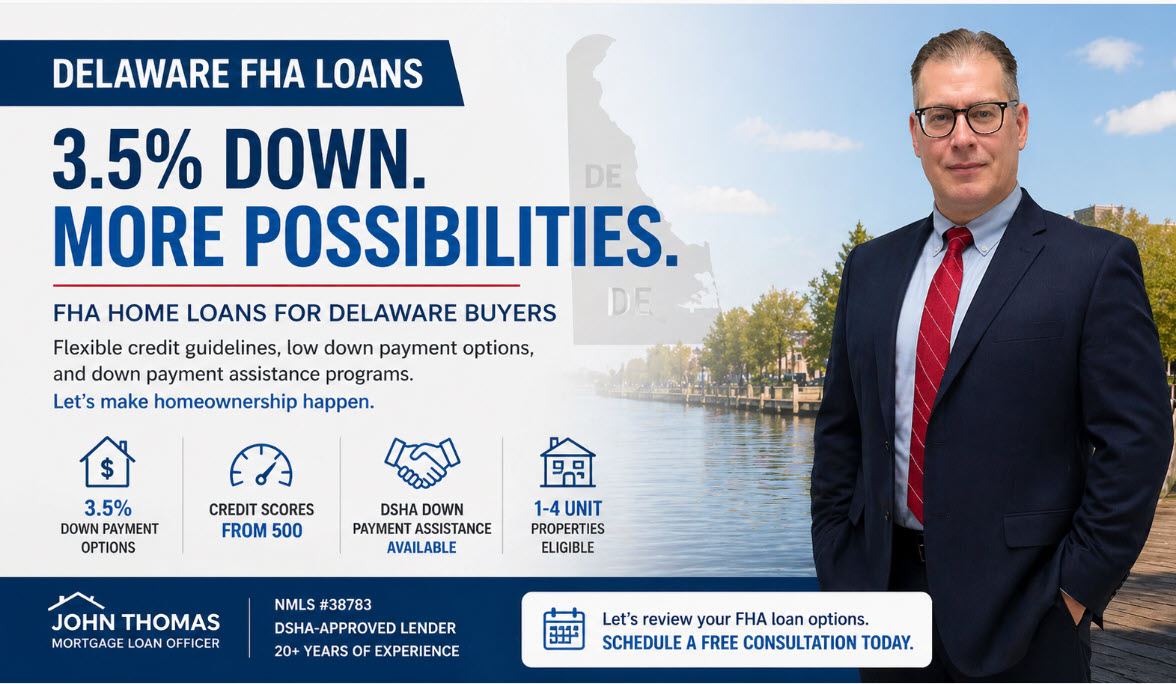

Delaware FHA Loans Quick Answer: A Delaware FHA loan is a 30-year fixed-rate mortgage insured by the Federal Housing Administration that lets you buy a home in New Castle, Kent, or Sussex County with as little as 3.5% down. 2026 FHA loan limits are $541,287 for Kent and Sussex Counties and $630,200 for New Castle County on a 1-unit home. Apply with John Thomas, NMLS #38783, DSHA-approved Delaware lender – call 302-703-0727.
Primary FHA requirements:
- 3.5% down payment with credit score 580+ (or 10% down with 500-579 via FHA Choice Loan)
- Owner-occupied primary residence in Delaware (no investment properties)
- Two-year employment history with documented income
- Property must pass FHA appraisal for safety and value
I’m John Thomas, NMLS #38783, and I’ve helped over 3,000 Delaware buyers get into homes – and FHA is the loan that gets used most often by first-time buyers in this state. Here’s why: 3.5% down, credit scores accepted as low as 500, debt-to-income ratios that flex up to 56.9% with compensating factors, and seller-paid closing costs up to 6%. We even have an FHA Choice Loan for buyers with credit scores between 500 and 620 – a niche most national lenders won’t touch. If you’ve been told your credit isn’t good enough or your savings aren’t big enough for a conventional loan, FHA is often the right starting point. This page walks through the 2026 FHA loan limits for Delaware, the credit score and down payment rules, the mortgage insurance numbers, how FHA pairs with DSHA down payment assistance, the FHA appraisal process, and the most common mistakes I see Delaware buyers make. Call 302-703-0727 with questions or apply online below.
Get Pre-Approved for a Delaware FHA Loan
Free pre-approval review. No pressure. Real answers from a DSHA-approved Delaware lender.
3,000+ Delaware buyers helped 1,000+ FHA loans closed NMLS #38783 · DSHA Approved
Table of Contents
What Is a Delaware FHA Loan and Who Qualifies?
An FHA loan is a mortgage insured by the Federal Housing Administration, which is governed by HUD (the U.S. Department of Housing and Urban Development). FHA doesn’t lend you the money directly – I do, through the John Thomas Team with AnnieMac Home Mortgage. FHA insures the loan, which lets me approve buyers with lower credit scores, smaller down payments, and higher debt-to-income ratios than I could on a conventional loan. The program is fully funded by the borrowers who use it. No taxpayer dollars support FHA – it pays for itself through the mortgage insurance premiums I’ll cover further down this page.
Roughly 1 in 5 U.S. home buyers uses an FHA loan. In Delaware, that ratio runs even higher among first-time buyers because of how the credit and down payment rules line up with what most first-time buyers actually have to work with. To qualify for a Delaware FHA loan, you need to meet these basic requirements:
- Credit score 580 or higher for the 3.5% minimum down payment
- Credit score 500-579 with 10% down (FHA Choice Loan in Delaware can sometimes help here)
- Two-year employment history with documented income (W-2s, pay stubs, or tax returns for self-employed)
- Debt-to-income ratio up to 46.9% housing, 56.9% total with compensating factors
- U.S. citizen or lawful permanent resident (HUD Mortgagee Letter 2025-09 – non-permanent residents are no longer eligible for FHA case numbers assigned on or after May 25, 2025)
- Owner-occupied primary residence only – no investment properties, no second homes
- Property must pass FHA appraisal for safety, structural soundness, and value
What Are the 2026 Delaware FHA Loan Limits by County?
FHA loan limits are set by HUD each year based on median home prices in each county. Two of Delaware’s three counties (Kent and Sussex) use the national FHA “floor” limit, while New Castle County qualifies for a higher limit because home prices in the Wilmington/Newark corridor are above the threshold. Multi-unit properties (2-4 unit) have higher limits because they’re considered eligible for FHA financing as long as you live in one of the units as your primary residence.
| County | 1-Unit | 2-Unit | 3-Unit | 4-Unit |
|---|---|---|---|---|
| New Castle County (most common) | $630,200 | $806,750 | $975,200 | $1,211,950 |
| Kent County | $541,287 | $693,050 | $837,700 | $1,041,125 |
| Sussex County | $541,287 | $693,050 | $837,700 | $1,041,125 |
For example, if you’re buying a home in New Castle County, the maximum base FHA loan amount is $630,200. The 1.75% upfront mortgage insurance premium gets added on top of that, so the total financed loan amount would be roughly $641,229. If your purchase price requires more than the FHA limit, you have three options: bring more money to closing to reduce the loan amount, switch to a conventional loan, or look at a jumbo loan if your numbers support it.
For a deeper dive on the FHA limits and how they’re calculated, see my 2026 Delaware FHA Loan Limits page.
How Much Down Payment Do You Need for an FHA Loan in Delaware?
The minimum down payment on an FHA purchase loan in Delaware is 3.5% of the purchase price if your credit score is 580 or higher. If your credit score is between 500 and 579, FHA requires 10% down. The 3.5% must go toward the down payment itself – it can’t be used for closing costs or pre-paid items. The maximum loan-to-value (LTV) is 96.50% on a purchase. On an FHA rate-and-term refinance you can go up to 97.75% LTV. On an FHA cash-out refinance you’re limited to 85% LTV.
Here’s the part most buyers don’t realize: FHA lets you cover 100% of the cash needed for down payment and closing costs from gift funds. If a parent, grandparent, sibling, fiance, or other approved donor gives you the money, FHA accepts it as long as we document it with a gift letter, the donor’s bank statement, and the wire/check trail. You don’t need any of your own savings to close on an FHA loan if you have a willing donor.
Acceptable sources for the FHA down payment:
- Your own seasoned savings (60+ days in your account)
- Gift funds from family, fianc, or close personal friend (with gift letter)
- Down payment assistance from DSHA or other Delaware DPA programs
- Employer-assisted housing programs
- Liquidated retirement accounts (401k loan or withdrawal – talk to a tax advisor first)
- Sale of personal assets (car, jewelry – needs paper trail)
How Much Is FHA Mortgage Insurance in 2026?
Every FHA loan requires two kinds of mortgage insurance: an upfront mortgage insurance premium (UFMIP) paid at closing (or financed into the loan), and an annual mortgage insurance premium (MIP) paid monthly as part of your mortgage payment. HUD reduced the annual MIP rate by 30 basis points effective March 20, 2023, and that lower rate still applies in 2026.
| FHA Mortgage Insurance Type | 2026 Rate | When You Pay |
|---|---|---|
| Upfront MIP (UFMIP) | 1.75% of base loan amount | At closing – usually financed into the loan |
| Annual MIP (less than 5% down) | 0.55% per year | Monthly, divided over 12 payments |
| Annual MIP (5% or more down) | 0.50% per year | Monthly, divided over 12 payments |
| Annual MIP (15-yr loan, ?90% LTV) | 0.15% per year | Monthly, divided over 12 payments |
How long do you pay annual MIP? If you put less than 10% down, FHA mortgage insurance stays for the life of the loan. The only way to drop it is to refinance into a conventional loan once you hit 20% equity. If you put 10% or more down, MIP automatically falls off after 11 years. So if you have the option to put down 10% on an FHA loan, you save a lot of money over the long run by avoiding lifetime MIP.
Real Delaware FHA Loan Scenario: How Much Cash Do You Actually Need?
Let me walk through a real example using the median Delaware home price of approximately $485,000 (per November 2025 ATTOM data). Numbers are rounded for clarity.
| Line Item | Amount |
|---|---|
| Purchase price | $485,000 |
| Down payment (3.5%) | $16,975 |
| Base loan amount | $468,025 |
| Upfront MIP (1.75%, financed) | +$8,190 |
| Total financed loan | $476,215 |
| Estimated closing costs (~3%) | $14,550 |
| Total cash to close (no seller help, no DPA) | ~$31,500 |
Now here’s where it gets interesting. If you don’t have $31,500 sitting around, you’re not done – you’re just getting started. Two strategies cut that cash-to-close number dramatically:
- Seller-paid closing costs. FHA lets the seller pay up to 6% of the purchase price toward your closing costs. On a $485,000 home, that’s up to $29,100 of help. Done right, this can wipe out closing costs almost entirely.
- Down payment assistance. Pair your FHA loan with one of Delaware’s DSHA DPA programs (3% to 5% of the loan amount in second-mortgage assistance) and you can show up to closing with as little as $1,000-$2,000 out of pocket if everything lines up right.
This is the conversation I have with first-time buyers every day. The headline number scares people. The structured plan doesn’t.
Can I Pair a Delaware FHA Loan with DSHA Down Payment Assistance?
Yes – and this is one of the most powerful combinations available to Delaware first-time buyers. FHA loans pair with all four currently-funded DSHA down payment assistance tracks. The DSHA program runs through Delaware State Housing Authority and is only available through DSHA-approved lenders. I’m DSHA-approved, so I can structure these pairings under one application.
| DSHA DPA Program | Assistance | First Mortgage Pairing |
|---|---|---|
| First State Home Loan | 3% of loan, 0% interest deferred 2nd | Welcome Home or Open Door |
| Keys4You | 4% of loan, 0% interest deferred 2nd | Welcome Home or Open Door |
| Take5 | 5% of loan, 0% interest deferred 2nd | Welcome Home only |
| Diamond in the Rough | 5% + FHA 203(k) renovation financing | Welcome Home only (FHA 203k) |
The DSHA first mortgage program (Welcome Home for first-time buyers, Open Door for repeat buyers) is what carries the FHA loan – and the DPA is layered on top as a 0% interest second mortgage that doesn’t require a monthly payment. You only repay the DPA when you sell the home, refinance the first mortgage, or stop using it as your primary residence. Income limits and a 620 minimum credit score apply for DSHA programs.
Delaware First-Time Buyer Transfer Tax Exemption
Delaware charges a 4% transfer tax on home purchases – split equally between buyer and seller under the standard Delaware Real Estate Sales Contract, so you’d normally owe 2%. But Delaware first-time buyers are exempt from the county portion of the buyer’s 2%, leaving you owing only the 0.75% state portion. On a $485,000 home, that’s a savings of about $6,000 at closing. Heads up: the exemption doesn’t apply when buying inside the City of Wilmington or City of Dover (and home builders sometimes write contracts requiring buyers to pay all 4%). Check your contract carefully.
Can I Get a Delaware FHA Loan with a Credit Score Below 620?
Yes – and this is one of the biggest advantages FHA has over conventional. Most national bank lenders won’t touch a borrower below 620 on a conventional loan, and even Fannie Mae’s average completed-loan FICO is well above 750. FHA’s official rules are much more flexible:
- 580 or higher qualifies for the 3.5% minimum down payment
- 500-579 requires 10% down (max 90% LTV)
- Below 500 – not eligible for FHA
Most lenders apply credit score “overlays” stricter than FHA’s actual minimums. A typical big bank might require 620 or even 640 minimum. We don’t. Through our FHA Choice Loan program, we can work with credit scores between 500 and 620 if your other compensating factors are strong (rental history, savings reserves, low DTI, stable employment).

If your score is in the low 600s and you’ve got bruised credit from past collections, judgments, or a prior bankruptcy, you may also qualify by waiting through FHA’s standard seasoning periods: 2 years from a Chapter 7 bankruptcy discharge, 1 year from a Chapter 13 (with on-time payments), and 3 years from a foreclosure. Don’t assume you have to wait – call me first.
FHA vs Conventional in Delaware: Which Loan Is Right for You?
FHA isn’t always the right answer. Conventional loans win when you have strong credit and at least 5% down because you can drop the mortgage insurance once you hit 20% equity – FHA mortgage insurance stays for the life of most FHA loans. Here’s the side-by-side that matters:
| Feature | Delaware FHA Loan | Delaware Conventional Loan |
|---|---|---|
| Min down payment | 3.5% (580+ FICO) / 10% (500-579) | 3% (Conventional 97) – 620+ FICO |
| Min credit score | 500 | 620 (most lenders 640+) |
| Max DTI | 56.9% with compensating factors | 45-50% |
| Mortgage insurance | UFMIP 1.75% + 0.55%/yr (life of loan if <10% down) | PMI (cancels at 20% equity) |
| Gift funds | 100% allowed | 100% allowed (with conditions) |
| Seller-paid closing costs | Up to 6% | Up to 3% (3-9% sliding by LTV) |
| 2026 NCC loan limit | $630,200 | $832,750 |
| Property types | Single-family, 2-4 unit, FHA condos, manufactured homes | Single-family, 2-4 unit, condos, manufactured homes, second homes, investments |
| Owner-occupancy required | Yes (primary only) | No (investment OK) |
| Assumable | Yes | No |
Quick rule of thumb: if your credit score is below 680 and you have less than 10% down, FHA is often the right starting point. If your credit is above 720 and you’re putting at least 5% down, conventional usually wins on long-term cost because PMI cancels and you avoid the upfront MIP. The break-even depends on your exact rate, score, and how long you plan to keep the loan. I’ll model both for you in 10 minutes – call 302-703-0727.
FHA vs VA vs USDA in Delaware: Which Government-Backed Loan Fits?
FHA isn’t the only government-backed loan available to Delaware buyers. Here are the boundary conditions that decide which one fits:
- FHA loan – anyone meeting the credit and DTI rules; 3.5% down minimum; works statewide on most property types.
- VA loan – eligible veterans, active-duty service members, and qualifying surviving spouses; 0% down, no monthly mortgage insurance, and no FHA-style upfront MIP. If you qualify, VA almost always beats FHA on long-term cost.
- USDA Rural Development loan – buyers under USDA income limits purchasing in eligible Delaware areas (most of Kent and Sussex Counties, plus rural pockets of New Castle); 0% down, lower mortgage insurance than FHA. Property must be in a USDA-eligible zone – I check the address before you make an offer.
Quick decision rule: if you’re a veteran, start with VA. If you’re buying outside the Wilmington/Newark/Dover urban corridor and your income is under USDA limits, check USDA first. Everyone else, FHA is usually the path. I’ll pre-approve you for whichever fits – call me to get started.
What Property Types Does an FHA Loan Allow?
FHA insures more property types than people realize. As long as you live in the property as your primary residence, FHA will finance:
- Single-family detached homes (the most common)
- Townhouses
- 2-4 unit owner-occupied properties – duplex, triplex, fourplex (you live in one unit, rent out the others – “house hacking”)
- FHA-approved condos (the condo project must be on FHA’s approved list – I check before you make an offer)
- Manufactured homes (FHA-only, double-wide minimum, 660+ credit score per DSHA overlay if pairing) – see my Delaware Manufactured Home Loans page
Buying a 2-4 unit on FHA is one of the smartest first-time-buyer plays I see. With 3.5% down, you can buy a duplex in Wilmington, live in one unit, rent the other for $1,500-$2,000/month, and let the rental income help cover your mortgage. FHA even lets us count up to 75% of projected rent toward your qualifying income.
What Does the Delaware FHA Loan Process Look Like Step-by-Step?
- Pre-approval (1-2 days). You complete the online application, I pull credit, you upload pay stubs, W-2s, tax returns, and bank statements. I’ll verify income, assets, employment, and run your credit through FHA’s automated underwriting (DU/LP/TOTAL Scorecard). You walk away with a pre-approval letter showing the loan amount, program, and any conditions.
- Property search (varies – usually 30-90 days). You shop with your real estate agent. I always tell my clients: don’t fall in love with a property without sending me the address first. I check the FHA condo approval status, look at the property profile, and confirm the price works inside FHA limits before you write the offer.
- Offer accepted & contract signed. I lock your interest rate, order the FHA appraisal, and the title company starts their work.
- FHA appraisal (5-10 business days). The FHA appraiser confirms value AND inspects the property for safety and structural soundness. They’ll flag peeling paint on pre-1978 homes (lead-based paint risk per EPA), missing handrails, broken windows, exposed wiring, deteriorated roofs, missing GFCI outlets, and similar safety items. If they require repairs, the seller has to make them before closing – and the appraiser comes back to verify.
- Underwriting (10-15 business days). The underwriter reviews your full file: income docs, asset statements, credit, appraisal, title work. They’ll either issue a clear-to-close or send back conditions to satisfy.
- Clear to close & final closing disclosure. By Federal law (TRID), you must receive your final Closing Disclosure 3 business days before closing. The CD shows your final cash to close, monthly payment, and every line item. Compare it to your initial Loan Estimate – they should line up.
- Final walk-through (24-48 hours before closing). Make sure required repairs are done and the home is in the condition agreed to.
- Closing. You sign at the real estate attorney’s office (Delaware law requires an attorney). You bring a cashier’s check or wire for your cash to close. Keys are yours that day.
From pre-approval to closing, a clean Delaware FHA purchase typically runs 30-45 days from contract acceptance. New construction takes longer because we’re waiting on the build.
Common FHA Mistakes Delaware Buyers Make
After 20+ years of doing these loans in Delaware, the same handful of mistakes come up again and again. Avoid these:
- Putting an offer on a non-FHA-approved condo. Not every condo is FHA-approved. If the project isn’t on HUD’s approved list, FHA won’t insure the loan. Always send me the address first – I check in 60 seconds.
- Underestimating the FHA appraisal repair process. If the appraiser flags peeling paint, missing GFCIs, or a deteriorated roof, the SELLER has to fix those items before closing – not you. If the seller refuses, the deal falls apart. This is why we often steer FHA buyers away from “as-is” foreclosure listings unless the seller is open to repairs or unless we use a 203(k) rehab loan.
- Not documenting gift funds correctly. If a parent gives you $15,000 for the down payment but transfers it cash without a paper trail, FHA won’t accept it. We need a gift letter, the donor’s bank statement, the wire/check copy, and proof it landed in your account. Two weeks of paperwork delay if you do it wrong.
- Buying a property the seller has owned less than 90 days (anti-flipping rule). FHA’s anti-flipping rule blocks any sale where the seller has held title less than 90 days. Between 91-180 days, we may need two appraisals. If you find a flip you love, check seller’s date of acquisition first.
- Maxing out credit cards or financing furniture before closing. Your debt-to-income ratio gets re-checked at closing. If you bought a $4,000 sectional on a Wells Fargo card last week, you may not qualify anymore. Don’t open or run up any credit during the transaction.
- Identity-of-interest transactions. If you’re buying from a relative or business associate, FHA caps the LTV at 85% (you’d need 15% down). There are exceptions for tenants buying from landlords and similar – talk to me before you sign anything.
- Skipping pre-approval and going straight to a real estate agent. No agent will spend serious time with a buyer who doesn’t have a pre-approval letter. And nothing breaks a deal faster than finding out at offer time that you don’t qualify for the price you’re trying to pay.
FHA Refinance Options in Delaware
Once you have an FHA loan, you have three refinance paths available:
- FHA Streamline Refinance – drops your rate without an appraisal, income docs, or credit check (in most cases). Up to 97.75% LTV. Fastest path.
- FHA Rate-and-Term Refinance – full re-underwrite to drop rate or change term. Up to 97.75% LTV.
- FHA Cash-Out Refinance – pull equity out as cash. Limited to 85% LTV (was 80% – recently raised).
If you have an FHA loan today and rates have dropped meaningfully since you closed, the streamline is usually the move. If you want to drop FHA mortgage insurance entirely, the better play is often refinancing into a conventional loan once you hit 20% equity.
FHA 203(k) Rehab Loan: Buy and Renovate in One Loan
FHA also offers a special 203(k) rehab loan that lets you finance both the purchase price AND the renovation costs into a single FHA mortgage. This is huge for buyers looking at Delaware properties that need work – kitchens, bathrooms, roofs, mechanicals, additions. There are two versions:
- Limited 203(k) – up to $75,000 in non-structural repairs (cosmetic upgrades, mechanicals, no additions)
- Standard 203(k) – unlimited repair budget, structural work allowed (additions, foundations, etc.)
Pair the FHA 203(k) Limited with the DSHA Diamond in the Rough program and you get 5% down payment assistance plus renovation financing – one of the most powerful programs in Delaware right now.
FHA One-Time Close Construction Loan in Delaware
If you’re building new instead of buying existing, FHA offers a One-Time Close (OTC) Construction Loan that lets you finance the land purchase, the construction, and the permanent mortgage in a single closing – all with 3.5% down. No second closing, no requalification mid-build, no construction interest payments while the home is being built (the construction interest is built into the loan). The program also works for placing a manufactured home on land you’re buying. Minimum 620 credit score for FHA OTC. This is the loan I recommend most often to Delaware buyers who can’t find an existing home that fits.
FHA 203(h) Disaster Victims Mortgage
If your home was destroyed or severely damaged in a Presidentially declared disaster area, the FHA 203(h) Disaster Victims Mortgage offers 100% financing – no down payment – to rebuild on the original lot or buy a replacement home anywhere in the country. Eligibility opens the day the President declares the disaster and runs for one year from that date. Both homeowners AND displaced renters qualify. Late payments after the disaster can be ignored in underwriting if they were caused by the displacement.
Powerful combo: FHA 203(h) can be paired with an FHA 203(k) rehab loan for buyers who want to purchase a damaged property and finance the repairs into one mortgage – a combination most national lenders don’t actively work. If you’ve been displaced by a disaster and need a Delaware lender who understands both programs, call 302-703-0727.
FAQ – Delaware FHA Loans
What is the minimum credit score for a Delaware FHA loan in 2026?
The official FHA minimum credit score is 500, but with a 500-579 score you must put 10% down. With a credit score of 580 or higher, you qualify for the standard 3.5% minimum down payment. Most national lenders apply credit overlays of 620 or 640, but our FHA Choice Loan can accommodate scores between 500 and 620.
What are the 2026 Delaware FHA loan limits?
For 2026, the 1-unit FHA loan limits in Delaware are $541,287 for Kent and Sussex Counties and $630,200 for New Castle County. Multi-unit limits are higher: in Kent and Sussex Counties the 2-unit limit is $693,050, 3-unit is $837,700, and 4-unit is $1,041,125. In New Castle County the 2-unit limit is $806,750, 3-unit is $975,200, and 4-unit is $1,211,950. Confirm your figures using HUD’s FHA Mortgage Limits lookup tool. These limits apply to FHA case numbers assigned on or after January 1, 2026.
How much down payment do I need for an FHA loan in Delaware?
With a credit score of 580 or higher, the minimum down payment is 3.5% of the purchase price. With a credit score between 500 and 579, the minimum is 10%. The down payment can come 100% from gift funds (with proper documentation), down payment assistance programs like DSHA, or your own savings. The 3.5% must go toward the down payment specifically, not closing costs.
How much is FHA mortgage insurance in 2026?
FHA loans require both an upfront mortgage insurance premium of 1.75% of the loan amount (typically financed into the loan) and an annual mortgage insurance premium that ranges from 0.15% to 0.75% per year depending on loan term, LTV, and loan size. Most 30-year Delaware FHA borrowers with less than 5% down pay 0.55% annually. With 5% or more down, the rate drops to 0.50%. These rates have been in effect since March 20, 2023, under HUD Mortgagee Letter 2023-05.
Can I pair a Delaware FHA loan with DSHA down payment assistance?
Yes. FHA loans pair with all four currently-funded DSHA down payment assistance programs: First State Home Loan (3% DPA), Keys4You (4% DPA), Take5 (5% DPA, Welcome Home only), and Diamond in the Rough (5% DPA + FHA 203k renovation, Welcome Home only). All DSHA programs require a 620 minimum credit score, must be used with a DSHA-approved lender like John Thomas Team, and have income limits by household size and county.
Can non-permanent residents still get an FHA loan in Delaware?
No, not for FHA case numbers assigned on or after May 25, 2025. HUD Mortgagee Letter 2025-09 revised FHA residency requirements so that only U.S. citizens and lawful permanent residents are eligible for FHA-insured financing. Citizens of the Federated States of Micronesia, Republic of the Marshall Islands, and Republic of Palau remain eligible under existing guidelines. Permanent residents must provide documentation proving lawful permanent resident status.
What happens during the FHA appraisal in Delaware?
The FHA appraiser performs two functions: determining the property’s value AND inspecting it for safety, structural soundness, and habitability. The appraiser checks for peeling paint on pre-1978 homes (lead-based paint risk), missing handrails, exposed wiring, deteriorated roofs, missing GFCI outlets, broken windows, and similar safety items. If repairs are required, the seller must complete them before closing, and the appraiser returns to verify. If less than 90 days have passed since the seller acquired the property, FHA’s anti-flipping rule may block the sale entirely or require two appraisals.
Can I buy a duplex or 2-4 unit property with an FHA loan in Delaware?
Yes, as long as you live in one of the units as your primary residence for at least one year. In Kent and Sussex Counties, FHA’s 2026 multi-unit loan limits allow you to finance a duplex up to $693,050, a triplex up to $837,700, and a fourplex up to $1,041,125. In New Castle County the figures are $806,750 for a duplex, $975,200 for a triplex, and $1,211,950 for a fourplex – verify your county’s exact multi-unit limits using the HUD FHA Mortgage Limits lookup tool. We can use up to 75% of projected rental income from the additional units to help you qualify, which makes FHA multi-unit loans one of the smartest house-hacking strategies for first-time Delaware buyers.
How long does the FHA loan process take in Delaware?
A typical Delaware FHA purchase loan takes 30 to 45 days from contract acceptance to closing. The timeline breaks down roughly as: 5-10 days for the FHA appraisal, 10-15 days for underwriting, and a few days for final closing disclosure delivery and closing logistics. The pre-approval itself usually takes 1-2 days once you’ve submitted the online application and supporting documents.
What’s the difference between an FHA appraisal and a home inspection in Delaware?
An FHA appraisal and a home inspection serve different purposes and you should always get both. The FHA appraisal is ordered by the lender and serves two functions: it determines the property’s market value and confirms the home meets HUD’s minimum property standards (no peeling paint on pre-1978 homes, working mechanicals, no exposed wiring, sound roof, working GFCIs, etc.). If the FHA appraiser flags repair items, the seller must complete those repairs before closing. A home inspection is hired separately by you, the buyer, from an ASHI-certified home inspector and goes much deeper than the FHA appraisal – covering the condition of the roof, HVAC, electrical, plumbing, foundation, and major systems. The home inspection is for your protection and gives you negotiation leverage on repairs or price. The FHA appraisal protects the lender. Both are essential.
Delaware FHA Loan Help Near You
The John Thomas Team is based in Newark, Delaware and helps FHA buyers across all three Delaware counties – New Castle, Kent, and Sussex. Most of the FHA buyers we work with are purchasing in Wilmington, Newark, Bear, Middletown, Hockessin, Claymont (New Castle County), Dover, Smyrna, Milford, Camden (Kent County), and Lewes, Rehoboth Beach, Seaford, Georgetown, Millsboro (Sussex County). Whether you’re buying near the office in Newark or down in Sussex County, we can review your credit, income, FHA loan limit, DSHA assistance options, and estimated cash to close before you start writing offers.
About John Thomas – Your Delaware FHA Lender


John R. Thomas
Branch Manager & Division Vice President of Sales · John Thomas Team with AnnieMac Home Mortgage
NMLS #38783 Top FHA Originator DSHA Approved Author
John has spent over 20 years originating Delaware FHA loans, helping more than 3,000 buyers across New Castle, Kent, and Sussex Counties get into homes with as little as 3.5% down. He has been recognized as a Top FHA Mortgage Loan Originator by Scotsman Guide from 2016 through 2025, and he’s one of the few Delaware lenders who actively works the FHA Choice Loan for sub-620 credit scores.
As a DSHA-approved loan officer, John specializes in pairing FHA loans with Delaware State Housing Authority down payment assistance – which is the strongest first-time-buyer combination available in this state. He’s the author of Your Guide to Buying Your First Home in Delaware and runs free monthly homebuyer seminars throughout the state.
John R. Thomas, NMLS #38783 · 248 E Chestnut Hill Rd, Newark, DE 19713 · 302-703-0727 · team@johnthomasteam.com
Schedule Appointment · See John Thomas Team on Google
YouTube · Facebook · Instagram · TikTok · X / Twitter · LinkedIn
Licensed in 17 states (AL, DC, DE, FL, GA, IN, KS, MD, MN, MO, NC, NJ, OH, PA, SC, TN, VA). NMLS #38783. The license list is a credential, not a service-area claim; day-to-day origination is Delaware and Maryland.
John holds a Bachelor of Science in Physics Education from the University of Delaware and a Master of Science in Curriculum and Instruction from Delaware State University, and is a Certified Mortgage Planner (CMP).
Apply for a Delaware FHA Loan Today
If you’re a Delaware home buyer with credit challenges, limited savings, or just want the lowest down payment available, an FHA loan is often the right starting point. I’ll review your credit, income, and goals, model FHA against conventional and DSHA pairings, and give you a clear plan that works within your real numbers – not a generic quote. There’s no cost or obligation to get pre-approved, and the conversation usually takes 15 minutes.
Get Pre-Approved for a Delaware FHA Loan
Free pre-approval review. DSHA-approved Delaware FHA lender. NMLS #38783.
Last Updated: September 2026 · John Thomas Team with AnnieMac Home Mortgage · Mortgage content reviewed by John R. Thomas, NMLS #38783.
2026 FHA loan limits per HUD; DSHA figures effective for reservations on or after June 8, 2026 and DSHA program rates from the sheet dated September 14, 2026 – comparison only, not a quote, not an APR and not a rate lock. Call 302-703-0727 for current figures.
John R. Thomas, NMLS #38783 | AnnieMac Home Mortgage NMLS #338923 | 248 E Chestnut Hill Rd, Newark, DE 19713 | 302-703-0727 | delawaremortgageloans.net
Copyright (c) 2026 John R. Thomas, All Rights Reserved. Equal Housing Lender.
